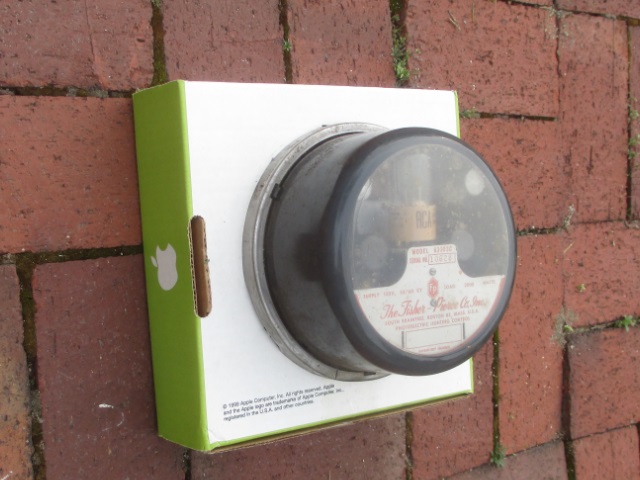
Meter Socket Photocontrol Conversion Adapter
Ever since streetlights were invented, there has been development of means to turn them on at sunset and off again at sunrise (or after a predetermined number of hours after which time few persons were expected to be out on the streets)..
At first the lights (mainly gas and oil) were lighted and extinguished one at a time manually.
Later, mechanical clocks and timers were used, including for gas and oil lights.
In the 1940's electronic devices (called photocontrols) were developed that sensed the amount of daylight in their surroundings. They used vacuum tubes including a tube that sensed the light level. For street lighting, many of these photocontrols were fitted into cylindrical containers with a diameter about that of a common electric meter, about 6 inches in diameter, (and usually about half the volume and depth). At the time that was the smallest size that they could be made.
Above: Mockup of a meter socket photocontrol.
The same socket and wall box used for electric meters was used for mounting and installing of these cylindrical photocontrols.
A few decades later, as vacuum tubes gave way to solid state (transistorized) circuitry a new standard was developed for photocontrols. This was a capsule about 3 inches in diameter and 2 to 3 inches high with a 3 prong twist lock plug on the bottom.
The item featured here is an adapter to replace a meter socket photocontrol with a twist lock photocontrol. The body is 3-5/8" in diameter by 8-3/4" tall not including the twist lock photocontrol. It weighs 3-3/4 lb., approximately the same as the meter socket photocontrol it replaces. It contains a relay to allow a twist lock photocontrol that can switch about a hundred watts to control a streetlight circuit of up to 3600 watts of incandescent streetlights.
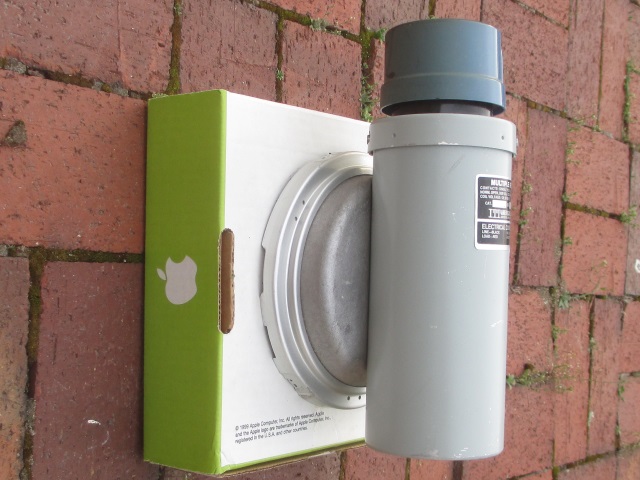
Pictured: The adapter with twist lock photocontrol in a mockup meter socket.
The vacuum tube meter sized photocontrols were too expensive to have one for each streetlight.
Most meter sized photocontrols handled between 2000 and 5000 watts of street lighting. Because of voltage drop in 120 volt and 240 volt circuits over distances of more than a few hundred feet, streetlight circuits using these supply voltages rarely powered more than ten lights each, and the total power consumption was usually less than 5000 watts.
A single circuit with a single switch or photocontrol can power several dozen streetlights using series wiring which is similar to that used in Christmas light strings. Such a circuit requires a supply voltage in the high hundreds or low thousands of volts. This adapter cannot handle such a voltage and cannot be connected directly into such a circuit.
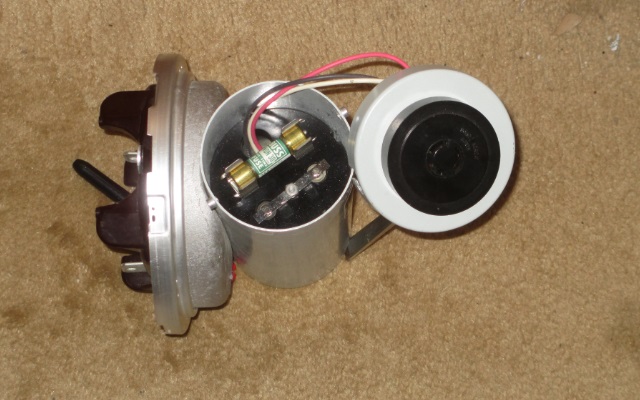
This adapter had a built in (here, 30 amp) fuse for the street lighting circuit it controlled.
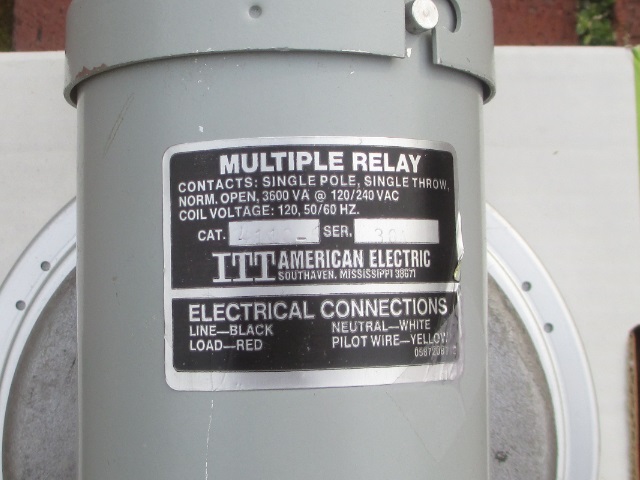
While the rating on the name plate is for combination 120/240 volt circuits, the connections on the mounting flange for the meter socket suggest control of a single 120 volt circuit or a single 240 volt circuit. Unlike an electric meter where the two pairs of contacts in back are for the two legs of a 120/240 volt circuit or supply, this adapter has a single pole switch connected to one pair of contacts. The other pair of contacts is labeled "neutral" and is a pass through.
.
As a point of information, for a short period of time, they did manufacture electric meter sized replacement photocontrols containing the same (miniaturized) solid state components as twist lock photocontrols so it was not always necessary to install an adapter such as the one featured here. Some of these miniaturized components could switch a lighting circuit of up to 5000 watts without the use of a relay.
Last updated May 2018
Go to other, unrelated, topics
All parts (c) copyright 2014, Allan W. Jayne, Jr. unless otherwise noted or other origin stated.
If you would like to contribute an idea for our web pages, please send us an e-mail. Sorry, but due to the volume of e-mail we cannot reply personally to all inquiries.